Have I got ADHD?
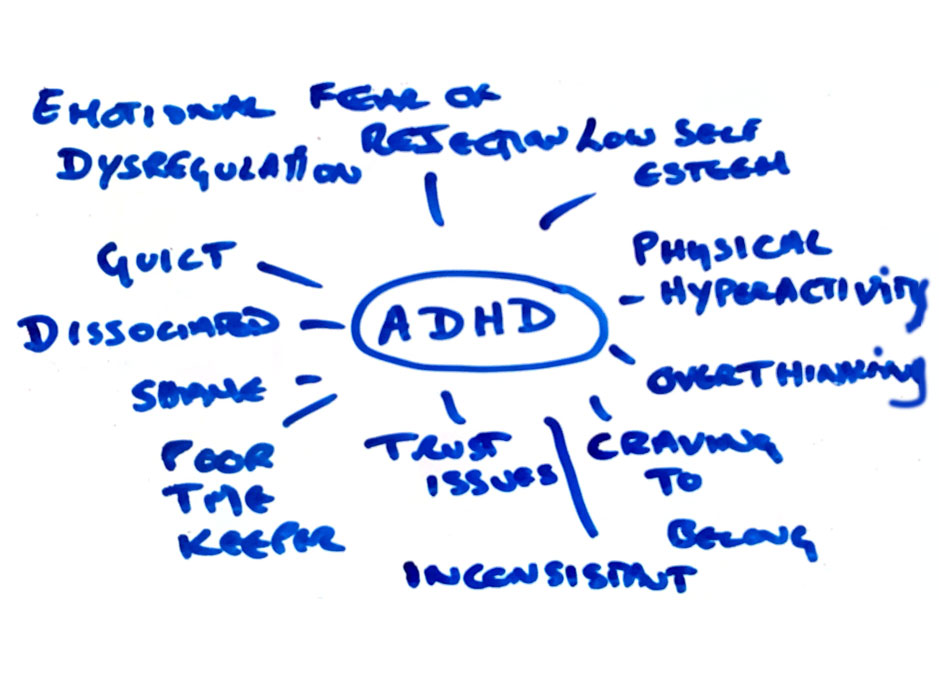
ADHD, sometimes known as ADD is all over the headlines right now, and some people are asking themselves the question ‘Have I got ADHD?’ with many on long waiting lists for assessment, or paying to go to private clinics. A lot of the symptoms of ADHD are familiar to all of us at some time in our life, you may be able to relate to many in the word-map above, the question is really about degree and how much this is affecting your life. There has been a lot of discussion about whether there could be a gene for ADD as it seems to be present at a high level within some families, or could it be that the behaviour within the family be contributing? Ultimately it seems from the research so far, there can be a predisposition to it, but other factors need to come into play. One thing that is generally agreed upon is, that poor bonding in early life with the primary care giver, can be a strong contributory factor, as it reduces the development of the right prefrontal cortex which is responsible for emotional regulation. Medication can help with ADHD but is not a stand-alone treatment. The underlying issues of emotional dysregulation, poor sleep and rumination, to name but a few, can be addressed with a range of talking therapies.
It is clear that these behaviours are unconscious, and the unconscious may be helped with hypnotherapy, as we are working directly with the unconscious and can help build some of the resources that had not been developed in childhood, and start to establish some new neural patterns. Neuroplasticity and our understanding of it, gives us new hope to deal with many difficulties that have been established through early negative learning patters.
There is an informative experiment called the still face experiment which shows how quickly a baby can become dysregulated when the parent’s attention is withdrawn. How quickly this rupture is repaired can made all the difference to the developing brain. How a young child will adapt their behaviour to appease the adults around them, has also been clearly demonstrated now and we can see how this will affect development if there is constant disruption/aggression and uncertainty around a small child.
We can only speculate how the attention parents now give their smart phones may affect children’s development. Also, how a child who is given a phone to keep them entertained, thus not develop strategies of self-soothing, may be impacting the rise of cases of ADHD in the modern world.
